Stock Market Volatility Is Back & Why Investors Should Stay the Course
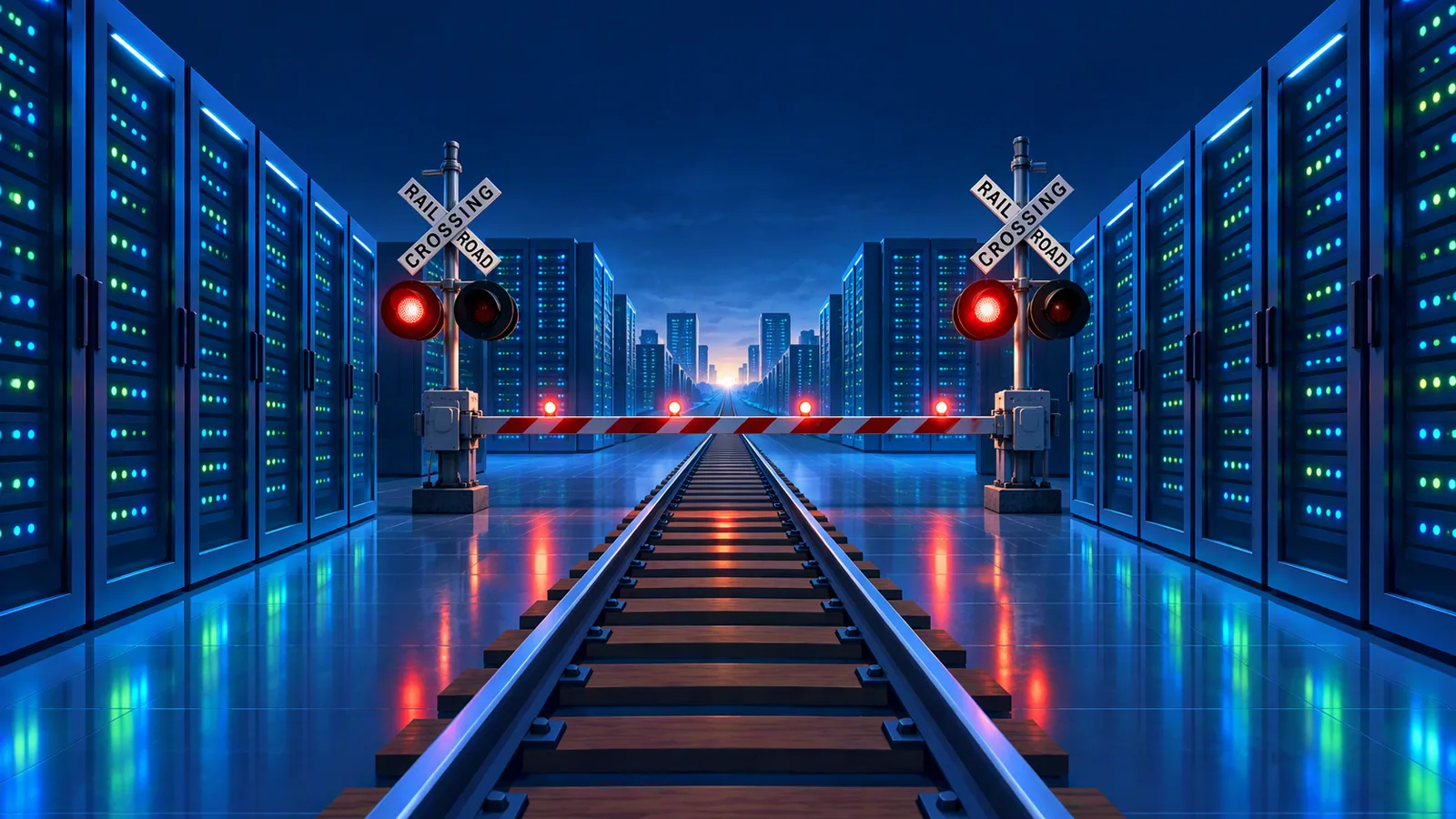
In the 1870s, America built more railroads than it could pay for. Over the past two weeks, the market has been asking whether we are doing the same with AI infrastructure: the data centres, and the chips and factories that fill them.
Jeff Kaminker, CFA, CFP, FRM · President and Portfolio Manager, Frontwater Capital Inc. · November 8, 2026
Disclosure: At the time of writing, Frontwater Capital clients and I hold Alphabet (GOOGL), Amazon (AMZN), Microsoft (MSFT), Intel (INTC), Marvell (MRVL), Micron (MU) and AMD (AMD). These companies are discussed to show how the market is judging AI spending. Nothing here is a recommendation to buy or sell them.
Two weeks ago, Alphabet had its worst session since the company went public in 2004. The shares fell more than 12.5% and lost roughly half a trillion dollars of market value in a quarter when Google Cloud revenue more than doubled.
Amazon delivered its fastest cloud growth in nearly five years and opened almost 5% lower the next morning. Intel beat expectations on earnings and lost 29% of its value the next day, after giving a revenue forecast below analyst expectations.
Last week, the selling spread to the companies that supply the build. On Thursday, November 5, the Nasdaq Composite fell 5.5%, its worst day since April 2025, and the PHLX Semiconductor Index, which tracks the largest chipmakers, fell about 12%. AMD dropped 17% two days after reporting the biggest quarter in its history. Micron, the memory chip maker whose profits have soared on AI demand, fell 17.5% that day and 22% over the week.
Read the news headlines and the takeaway is that cracks are starting to form within the AI bubble. Read the filings and something more useful happened. Investors stopped grading these companies on revenue growth and started grading them on how they manage their spending, especially on data centres.
In our view, the AI revolution is here to stay, and that is not up for debate. The real question is whether today's extraordinary spending on AI infrastructure is justified, and whether these companies will earn an acceptable return on it. A second question follows: what should a long term investor do in a market like this one, where technology stocks such as Alphabet, Intel, Marvell, AMD and Micron have fallen by double digits in a single day?
As long term investors, we are not particularly rattled by these questions, or by the volatility behind them. That said, it is worth looking at history to understand how past infrastructure booms have behaved, and what lessons we can draw from them.
A Lesson From 1873
In September 1873, the New York Stock Exchange closed its doors for ten days. Nobody doubted that America needed railroads. The trouble was that too many companies had borrowed to build too much track, too fast, ahead of the traffic that was supposed to pay for it. In the years that followed, 89 of the country's 364 railroads went bankrupt.
The trains kept running. The investors who paid for the track were a different story.
The more recent rhyme is fibre optic cable. In the four years to 2001, telecom companies laid about $90 billion of fibre. By mid 2001, Merrill Lynch estimated that only 2.6% of that capacity was in use. Telecom became one of the two largest sources of corporate bond defaults by dollar value that year, a record year for defaults. Global Crossing and WorldCom went bankrupt.
Today, the market is asking the same question about AI infrastructure. Are we building too many data centres, chips and chip factories, too fast, with money that has not yet been earned?
Why the Volatility Does Not Rattle Us
With that history in mind, it is tempting to jump on the bear market bandwagon and start selling. We believe that would be a mistake, because there is one significant difference between those booms and this one. The largest AI spenders today are large, highly profitable companies such as Alphabet, Amazon and Microsoft, and none of them is a single bet on AI infrastructure.
They earn revenue and profit from many sources at once: search and advertising, video, software, online retail and cloud. Investing heavily in new areas is part of what well run businesses of this scale are built to do, and their existing profits let them take calculated risks that a younger company could not.
That changes the railroad question. If part of the data centre build earns less than hoped, much of that capacity can still be put to work for businesses that already make money. A disappointing bet would hurt. On its own, it would not sink the company.
That protection has limits. A diversified company can still overpay for growth, and its shares can stay down longer than investors expect. Intel, a supplier that depends far more on a single line of business, has much less of it. But a sharp move after one earnings report is not, by itself, a reason for a long term investor to change course.
The Scorecard
| Company | Reported | What beat | What the market punished | First reaction |
|---|
| Alphabet | Oct. 28 | Revenue up 25% to $127.6B; Cloud up 103% | Quarterly capital spending of $51.4B; free cash flow of negative $9.1B; GAAP earnings per share of $2.12 vs. about $3.01 expected | Down 12.6% on Oct. 29 |
| Microsoft | Oct. 28 | Azure up 48% to $33.2B; revenue up 19% to $92.3B | Little; spending came in below plan on supplier delays | Opened up 1.7% on Oct. 29; closed down 0.2% |
| Amazon | Oct. 29 | AWS up 39% to $46.0B; record 13.9% operating margin | Earnings per share of $1.89, below estimates; revenue slightly short | Opened down 4.6% on Oct. 30; closed down 1.4% |
| Intel | Oct. 29 | Revenue up 21% to $16.5B; adjusted earnings per share of $0.52 vs. about $0.41 expected | Fourth quarter revenue forecast of $15B to $16B vs. about $17.1B expected | Opened down 25.8% on Oct. 30; closed down 28.6% |
| AMD | Nov. 3 | Record revenue up 45% to $13.4B; Data Center up 97% to $8.5B; adjusted earnings per share of $2.09 vs. about $1.94 expected; fourth quarter guidance of about $17B | Little in the report itself; gaming sales fell 40%. Caught in the sector selloff after the midterm elections | Up 1.0% on Nov. 4; down 17.3% on Nov. 5 |
| Micron | No report | DRAM selling prices up roughly 180% in fiscal 2026, driving record profits; about 3.7 times expected earnings after the drop | Fears that memory prices have peaked; a cautious outlook from Kioxia; a paused plant in Taiwan | Down 17.5% on Nov. 5; down 22.0% for the week |
Sources: company earnings releases and conference calls, October 28 and 29 and November 3, 2026; contemporaneous reporting by CNBC, Yahoo Finance and Seeking Alpha, November 2 to 6, 2026. Micron's next earnings report is expected in December. Share price moves are regular session prices from Interactive Brokers market data, measured against the previous day's close. GAAP means the standard accounting rules companies must report under. All figures in U.S. dollars.
Six companies. Five reported strong growth where it matters most, and the sixth, Micron, is earning record profits on record memory prices. None was rewarded. The best any of them managed was to escape punishment.
That spread is the story.
The Cost of Keeping Up
The largest technology companies are in the middle of one of the biggest capital programs in corporate history. Capital spending, or capex, is money spent on long lived assets: data centres, chips, power.
Alphabet held its 2026 capex guidance, the spending range management has told investors to expect, at $195 billion to $205 billion. Microsoft trimmed its own forecast to $170 billion from $175 billion, not for lack of appetite, but because chip suppliers could not deliver on time. Analyst estimates compiled by CNBC put combined spending by the largest cloud providers above $1 trillion next year.
And the meter is still running. Alphabet's chief financial officer, Anat Ashkenazi, told analysts: "We continue to expect our capex to increase significantly in 2027."
Now consider the split decision. On the same day, on the same theme, Alphabet sank and Microsoft barely moved. Both are spending at historic rates. Both reported accelerating cloud growth. The clearest difference was free cash flow: the cash left after a company pays for its operations and its investments. Microsoft delivered its growth without a cash surprise. Alphabet delivered its growth alongside negative free cash flow.
That is the shift. For two years the market asked whether AI demand was real. It now has its answer. The new question is when the spending turns into cash, and investors are no longer willing to take that on faith.
A drop in price is not a drop in quality. But once investors start checking the receipts, promises stop being enough.
Is AI the Next Railroad?
Every infrastructure boom eventually asks the same question: are we building ahead of demand, or ahead of our ability to pay for it?
Railroads answered that question badly. Fibre optic cable did too. Both created enormous economic value. Both destroyed enormous amounts of investor capital along the way.
The part worth remembering is that the track and the fibre did not disappear. The railroads became the backbone of the American economy. The unused fibre was bought out of bankruptcy at a discount and put to work as internet traffic caught up. The technology won. Many of the people who financed it lost.
An infrastructure boom can be right about the future and still be wrong about the price.
So is AI the next railroad?
We do not think the analogy is exact.
The railroad and fibre builders were mostly young companies funding construction with borrowed money, betting on demand that had not yet arrived.
Today's largest builders are different. Alphabet, Amazon, Microsoft and others are highly profitable businesses funding much of their expansion from existing cash flows. They are not building infrastructure in the hope that customers arrive. In many cases, they are expanding capacity against demand that already exists and contracts that have already been signed.
That does not eliminate risk.
The cushion is real. The world's largest companies can absorb costs that would cripple smaller competitors. But the cushion is not unlimited, and the past two weeks showed signs of strain. Alphabet's free cash flow turned negative. Intel does not expect positive free cash flow this year. When spending begins to outrun cash generation, investors naturally become more demanding.
The market spent the past two weeks separating spending from earning. That is uncomfortable to watch and healthy to have. In many ways, that is exactly what markets are supposed to do.
History offers an uncomfortable lesson for investors. Revolutionary technologies often prove transformative long before they prove profitable.
Railroads required track before earnings.
The internet required fibre before e-commerce.
Cloud computing required data centres before recurring revenue.
Artificial intelligence may follow the same path.
The technology can succeed even while investors spend years debating the price of getting there.
We remain optimistic. In our view, the companies building this infrastructure with their own cash are well placed to turn today’s spending into tomorrow’s profits, for patient investors.
If you would like a second set of eyes on your own portfolio, book a complimentary 60-minute introductory meeting, by Zoom or in person, at www.frontwater.ca.
Jeff Kaminker, CFA, CFP, FRM · President, Frontwater Capital Inc. · www.frontwater.ca
Frontwater Capital Inc. is an independent, fee-only registered Portfolio Manager based in Toronto. This article is for general educational purposes only and is not investment, legal or tax advice, nor a recommendation to buy or sell any security. Securities mentioned illustrate our thinking and are not recommendations. They may not be suitable for every investor. Past performance is not indicative of future results. Historical figures are drawn from published economic histories and contemporary reporting, as cited in our source notes. Company figures are drawn from company earnings releases and conference calls of October 28 and 29 and November 3, 2026, and from contemporaneous market reporting; share price moves are regular session prices from Interactive Brokers market data. Index moves, valuation measures and analyst estimates are from contemporaneous third party reporting. Company projections quoted are management's, not Frontwater's.